

This 30-day plan is a structured lifestyle framework, not a substitute for medical treatment. If you're on medication or insulin, changes to diet and activity can affect your dosage needs — please start this plan alongside your doctor, not instead of them.
If you've just been told your blood sugar is high — or you've been living with diabetes for years and feel like you've lost control of it — you've probably typed some version of "how to control diabetes" into Google at 11pm. You’re not alone. India now has the largest population of people with type 2 diabetes in the world, and unlike in many other countries, Indians tend to develop it younger and at a lower body weight.
The good news: blood sugar responds fast to the right combination of habits. Most patients who commit to a structured 30-day reset see meaningful, measurable improvement in fasting and post-meal readings — often before the month is even over. This guide walks you through exactly what to do, week by week, built around how Indian meals, routines, and family life actually work.
Learn Your Numbers First
Before changing anything, know what you're aiming for. These are the ranges most doctors — including under ICMR and American Diabetes Association guidance — use as targets for adults with diabetes:
| Test | Healthy / Non-diabetic | Target if you have diabetes |
|---|---|---|
| Fasting blood sugar | 70–99 mg/dL | 80–130 mg/dL |
| 2 hours after a meal (PPBS) | Under 140 mg/dL | Under 180 mg/dL |
| HbA1c (3-month average) | Below 5.7% | Below 7% (individualised with your doctor) |
These targets aren't one-size-fits-all — your doctor may set a slightly different goal depending on your age, other health conditions, and how long you've had diabetes. Want the full breakdown by age and risk category? Our complete guide to what is a good HbA1c level.
Why “30 Days” — And What This Plan Really Does
Thirty days won't cure diabetes — and be cautious of anyone who promises that it will. What it can do is reset the daily patterns that are keeping your sugar high: irregular meal timing, low fibre, sedentary evenings, poor sleep and unmanaged stress. These changes bring numbers down significantly within a month for many people with newly diagnosed or borderline type 2 diabetes. For some, especially those on medication, it is the base which makes the medication work better. In either case, the plan below is meant to be followed with the oversight of your doctor, checking in at the end of each week.
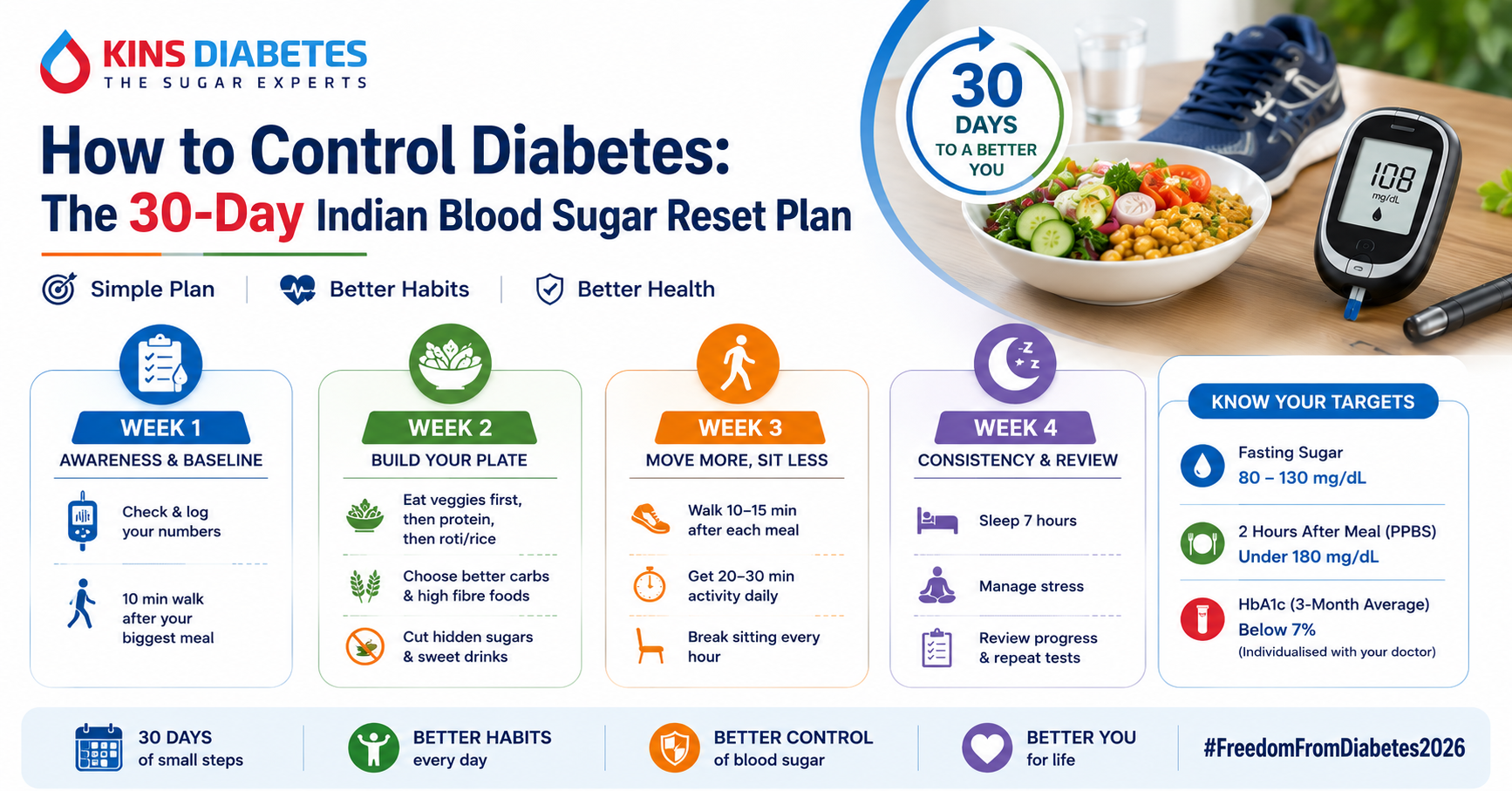
Week 1 — Awareness & Baseline (Days 1-7)
Goal: understand your initial position before you change anything.
- Test and log fasting sugar each morning and a post meal reading each day. Same meal helps to see patterns.
- Write down honestly what you eat for all 7 days – most people are surprised by portion sizes and hidden sugar (tea, snacks, sauces) once they see it on paper.
- Walk for 10 minutes after your largest meal of the day. Studies show that a short walk after a meal blunts the glucose spike significantly -- more than the same walk taken before a meal.
- Don’t change your medication without talking to your doctor, even if your numbers look better this week.
If you haven’t had a full diabetes profile in the last 3 months, book in a baseline consultation: it gives you (and us) a real number to measure this 30 day plan against.
Week 2 – Build Your Plate (Days 8-14)
Goal: change what's on your plate, not how much you eat at once.
- First eat vegetables/salad, then protein and dal then rice or roti last. This one sequencing change slows the glucose spike from the same meal.
- Cut down your rice/roti portion by a third and fill the void with dal, sabzi or salad – not more oil or ghee.
- Replace white rice with a combination of rice + millet (ragi, jowar, bajra) two or three times a week. Millets are easily available in North Bengal and they are low on glycaemic index.
- Watch out for the "invisible" sugar: sugar in tea/coffee, biscuits with evening tea, and fruit juice all add up quickly and are the easiest wins to cut.
- If you eat Bengali staples such as muri, chira, or mishti doi, you do not need to cut them out — portion and timing are more important. Refer our complete Bengali diabetes diet chart for more do’s and don’ts.
Week 3 — Move More Sit Less (Days 15-21)
Objective: turn movement into a daily non-negotiable, not a weekend event.
- Don’t just walk once a day, walk 10 to 15 minutes after each major meal. Studies show it is just as good as a long walk for preventing post-meal sugar spikes, and much easier to maintain.
- Walk after meals. Get 20-30 minutes of brisk activity most days. Walk, cycle, do housework that gets your heart rate up.
- If your work involves sitting, then get up and walk around for 2-3 minutes each hour. Even otherwise active people who sit for long periods without moving have poorer blood sugar control.
- Twice a week, add light resistance work — bodyweight squats, resistance bands or carrying groceries. Muscle is important for sugar control even when you are not working out because your body stores and burns glucose in your muscle.
Week 4 — Consistency, Sleep & Review (Days 22-30)
Goal: solidify the habits, get a real sense of your progress.
- Sleep 7 hours. Bad sleep increases insulin resistance by the next day, even if you haven’t changed your diet or exercise.
- Maintain consistent meal timing — large meals after long gaps cause bigger sugar swings than smaller, regularly-timed meals.
- Deliberately control stress. Stress hormones directly raise blood sugar. Even 10 minutes of breathing exercises or a short walk can help during high-stress days.
- On Day 30, repeat your baseline tests (fasting, PPBS, and — if it's been 3 months — HbA1c) and book a follow-up to review results with your doctor and plan the next phase.
Mistakes That Hold You Back
- Skipping meals to “save” on sugar – this often backfires with a bigger spike at the next meal.
- People only testing fasting blood sugar and not post meal numbers which are often the real story.
- Over-restricting rice/roti to zero — extreme changes are difficult to maintain, and can lead to other problems. Moderation is better than prohibition.
- Stopping medication because week-1 numbers look good -- always consult your doctor before any medication change
When Should I Call My Doctor Right Away
This plan is supportive of control -- it is not a substitute for medical care. If you notice: Contact your doctor immediately if you notice:
- Fasting sugar >250 mg/dL, or any time >300 mg/dL
- Symptoms of very low sugar — shakiness, sweating, confusion — particularly if you're on medication
- Non-healing wounds, numbness in the feet or blurred vision.
- Unexplained weight loss, constant thirst, or frequent urination that’s not improving
References:
- ICMR new rules coverage — https://www.newsheads.in/lifestyle/news/icmr-new-rules-for-type-2-diabetes-management-patients-add-up-to-729-million-article-14713
- NIH StatPearls, Blood Glucose Monitoring — https://www.ncbi.nlm.nih.gov/books/NBK555976/
- ADA Standards of Care 2026, Ch. 6 — https://diabetesjournals.org/care/article/49/Supplement_1/S132/163927/6-Glycemic-Goals-Hypoglycemia-and-Hyperglycemic
- ADA Standards of Care 2026, Ch. 6 (PMC mirror) — https://pmc.ncbi.nlm.nih.gov/articles/PMC12690178/
Frequently Asked Questions
Read More Articles

Posted on 26-08-2026
Diabetes Diet Chart: What to Eat and What Not to Eat in Diabetes

Posted on 13-08-2026
Best Diabetologist in Siliguri: How to Choose the Right Diabetes Doctor

Posted on 07-08-2026
ডায়াবেটিসে কী খাবেন, কী খাবেন না? সম্পূর্ণ বাংলা ডায়েট চার্ট

Posted on 05-06-2026
Polyendocrine Metabolic Ovarian Syndrome (PMOS): Understanding the New Name for PCOS

