

But the real problem is that gap. And it is the reason two people can leave the same diagnostic center with the same “normal-ish” report, when one of them already has early kidney or nerve damage that nobody looked for.
This guide covers what a full body checkup usually includes, which diabetes tests to confirm before you pay, and the full list of tests that matter if diabetes runs in your family or has already been diagnosed.
What is a full body checkup, like, really?
A 'full body check up' is not a standardized medical protocol. This is a commercial package. And what goes into each hospital, lab or diagnostic center is chosen by it, and packages at the same price point can vary widely in what they actually test.
Most packages are built around:
- Blood Tests (Complete Blood Count)
- Blood sugar (usually fasting)
- Lipid panel
- Liver function test (LFT)
- KFT (Kidney Function Test) - usually just creatinine and urea
- Thyroid (TSH)
- Routine examination of urine
- Sometimes an ECG, chest x ray or abdominal ultrasound
What “full body” usually doesn’t cover: eye screening for the retina, nerve sensation testing, urine albumin testing or a foot examination. These are precisely the tests that really matter after blood sugar has been high for a few weeks.
So the honest answer to the question is: a full body checkup often has a diabetes screening test but rarely has a diabetes assessment. That's two very different things.
Part 1: Three Tests for Diabetes Screening
1. Fasting Blood Sugar (FBS/FPG)
Measures blood glucose after 8–10 hours without food. This is the most common sugar test included in health packages because it is cheap and quick.
What it misses: Some people have near-normal fasting sugar but high spikes after eating. Thus a fasting value alone can be reassuring while glucose regulation is already disturbed.
2. Post Prandial Blood Sugar (PPBS) - 2 hours after meals
Tests how your body handles a glucose load. Post meal rise in South Asians is often earlier than fasting rise and missing this test can lead to delay in detection.
3. Glycated hemoglobin (HbA1c)
Average blood glucose for the last 2-3 months approximately. Nothing to fast for. It is not affected by what you ate yesterday so it is the most stable single indicator of long term glucose control.
Specifically confirm this one. HbA1c is often not in budget packages and is the one test most worth adding if it is missing.
Reference ranges, standard
These are the commonly used diagnostic categories (American Diabetes Association criteria and also used in Indian clinical practice). They're supposed to read your report, not self-diagnose.
| Test | Normal | Prediabetes | Diabetes range |
|---|---|---|---|
| Fasting blood sugar | Below 100 mg/dL | 100–125 mg/dL | 126 mg/dL or above |
| 2-hour post-meal / OGTT | Below 140 mg/dL | 140–199 mg/dL | 200 mg/dL or above |
| HbA1c | Below 5.7% | 5.7%–6.4% | 6.5% or above |
| Random blood sugar | - | - | 200 mg/dL or above with symptoms |
One abnormal value is a signal, not a diagnosis. Confirmation usually involves a repeat test on a different day or a second abnormal test on the same sample. Certain conditions such as anemia, haemoglobinopathies such as thalassemia trait (not uncommon in this part of the world), recent blood loss, pregnancy and chronic kidney disease can give misleading HbA1c. This is one of the reasons results need clinical interpretation and not self-comparison to a chart.
Part 2: The Tests Most Packaging Doesn’t Include
If you have diabetes, prediabetes, a family history or risk factors, these are the tests that change management decisions. The first step is testing for the disease. The second step is screening for what the disease is doing and this is where most check-up packages fall short.
Lipid Profile – Link to the Heart
The basic lipid profile consists of total cholesterol, LDL, HDL and triglycerides. Most packages have this built in, but two things are often missed:
- Non-HDL cholesterol is a better risk marker than LDL alone in diabetics and it is just total cholesterol minus HDL – ask the lab to report it
- With insulin resistance you typically see high triglycerides with low HDL, even if LDL looks OK. A report overall can be flagged “normal,” but still show this pattern. “Lipids are not an optional add-on. Cardiovascular disease is the number one cause of death in people with diabetes.
Kidney Function — and the test that is so often missing
Standard KFT panels report serum creatinine and urea and sometimes eGFR. That is useful, but creatinine only increases when a large part of kidney function has been lost.
The earlier marker is urine albumin-to-creatinine ratio (UACR), a simple spot urine test that detects small amounts of protein leaking through the kidney filters often years before creatinine changes.
| Marker | What it shows | Commonly in packages? |
|---|---|---|
| Serum creatinine | Current filtration load | Yes |
| eGFR (calculated) | Estimated kidney filtration rate | Yes |
| Urine ACR | Earliest sign of kidney involvement | Yes |
| Urine routine | Protein, sugar, infection | Yes |
If you ask for exactly one addition to a package, many clinicians would put urine ACR at or near the top of the list.
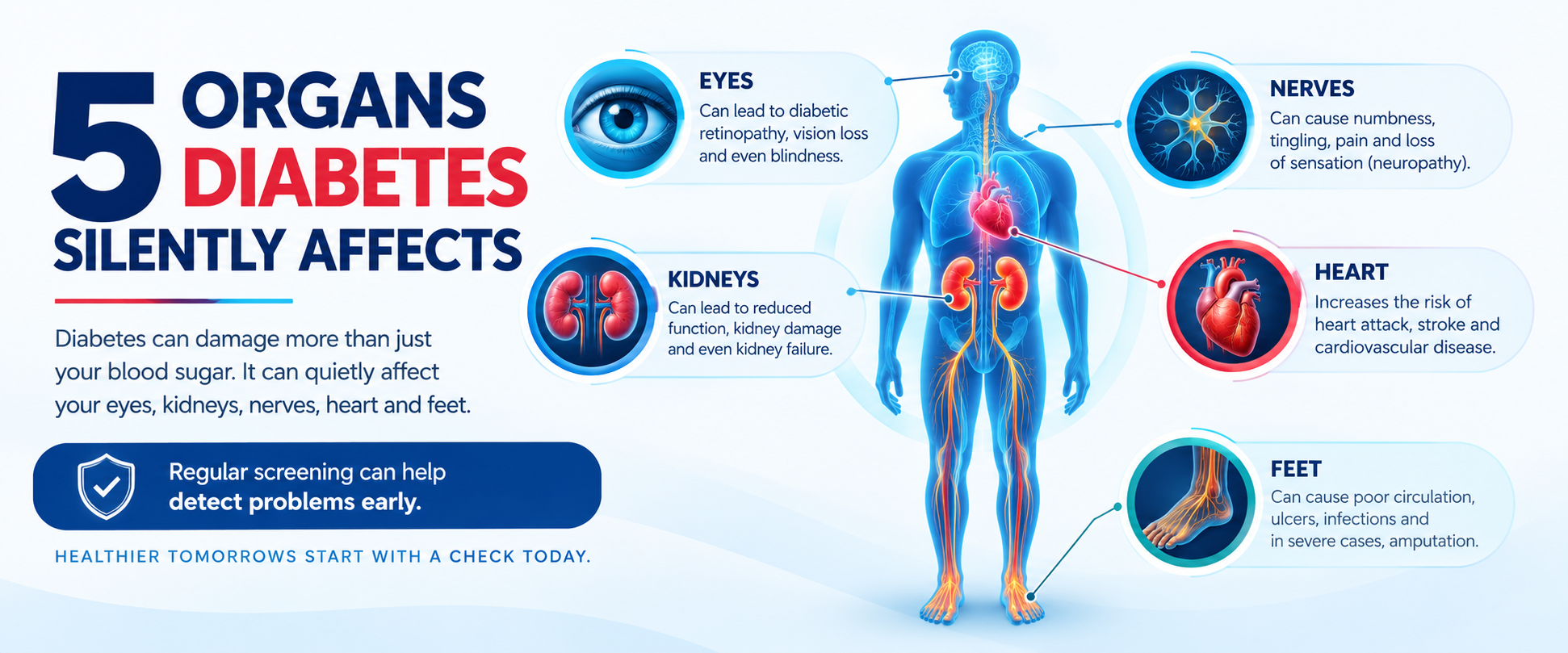
Eye screening – diabetes retinopathy
Retinopathy tends to occur without pain, redness or early change in vision. Often when vision is blurred the condition is not in its earliest stage.
The screening is a dilated eye exam or retinal (fundus) photography—not the vision-chart test you get at the optical shop that checks sharpness, not the health of your retina.
Timing commonly followed in practice:
- Type 2 diabetes: eye screening at diagnosis because glucose may have been elevated for years before diagnosis
- Type 1 diabetes: usually within 5 years of diagnosis
- Pregnancy in pre-existing diabetes early pregnancy and follow-up in pregnancy
- The ophthalmologist will decide how often the tests need to be repeated, depending on the findings
Nerve and Foot Examination - peripheral neuropathy
Diabetic foot ulcers are preceded by nerve damage in the feet in most cases, and this is one of the most under-screened and consequential complications in routine Indian practice.
A good foot and nerve exam is fast, doesn’t need a blood draw and usually includes:
- 10 g monofilament test: a fine filament pressed on specific points on the sole to assess protective sensation. If you lose this sensation, an injury may go unnoticed.
- Vibration perception – 128Hz tuning fork, big toe or biothesiometer for a graded reading
- Pinprick and temperature sensation - Small fiber nerve function
- Testing of ankle reflex
- Visual foot inspection – callous, cracks, nail changes, deformity, ulcers, fit of footwear.
- Check pulses in the feet and calculate the ankle-brachial index (ABI) as needed for circulation
If you have diabetes, make sure you get a foot exam at least once a year. It costs next to nothing, and it’s the test that prevents the most damage.
Blood Pressure, Weight and Waist
Easily. For free. And all too often ignored. Blood pressure control is equally vital as sugar control in protecting the kidneys and eyes.
Asian Indians are at greater risk than standard international cut-offs indicate. Typical thresholds are as follows:
- BMI 23 kg/m2 and above – overweight range
- Men: waist circumference 90 cm and above, women: waist circumference 80 cm and above
Why a “normal BMI” doesn’t exclude metabolic risk in this group? Because central fat is more important than total weight.
Thyroid Function (TSH)
Thyroid problems are more common in people with diabetes, especially type 1 diabetes and autoimmune thyroid disease. Untreated hypothyroidism also aggravates lipid levels and weight patterns. Most packages will include TSH – check yours does. If it is abnormal, further evaluation and follow up with a thyroid specialist may be recommended.
Vitamin B-12
Relevant for anyone on long term metformin which is associated with reduced B12 absorption over time. Low B12 can cause tingling and numbness that mimic diabetic neuropathy.
Distinguishing between the two changes treatment. Not part of the usual packages, if you have been on metformin for years or you have symptoms of neuropathy it is worth asking for.
Liver – LFT and Fatty liver evaluation
Fatty liver disease is often associated with type 2 diabetes and insulin resistance. LFT and abdominal ultrasound give a reasonable picture initially. Elevated enzymes here are something you do not want to put off for later – they are something to discuss with your doctor.
Examination of the Heart
Sometimes, a resting ECG is included. Based on your age, symptoms, how long you’ve had diabetes and your risk factors, your doctor may recommend additional testing such as a stress test or echocardiogram. Importantly, in longstanding diabetes, pain may be blunted or absent due to nerve involvement and therefore risk assessment should not be delayed until symptoms occur.
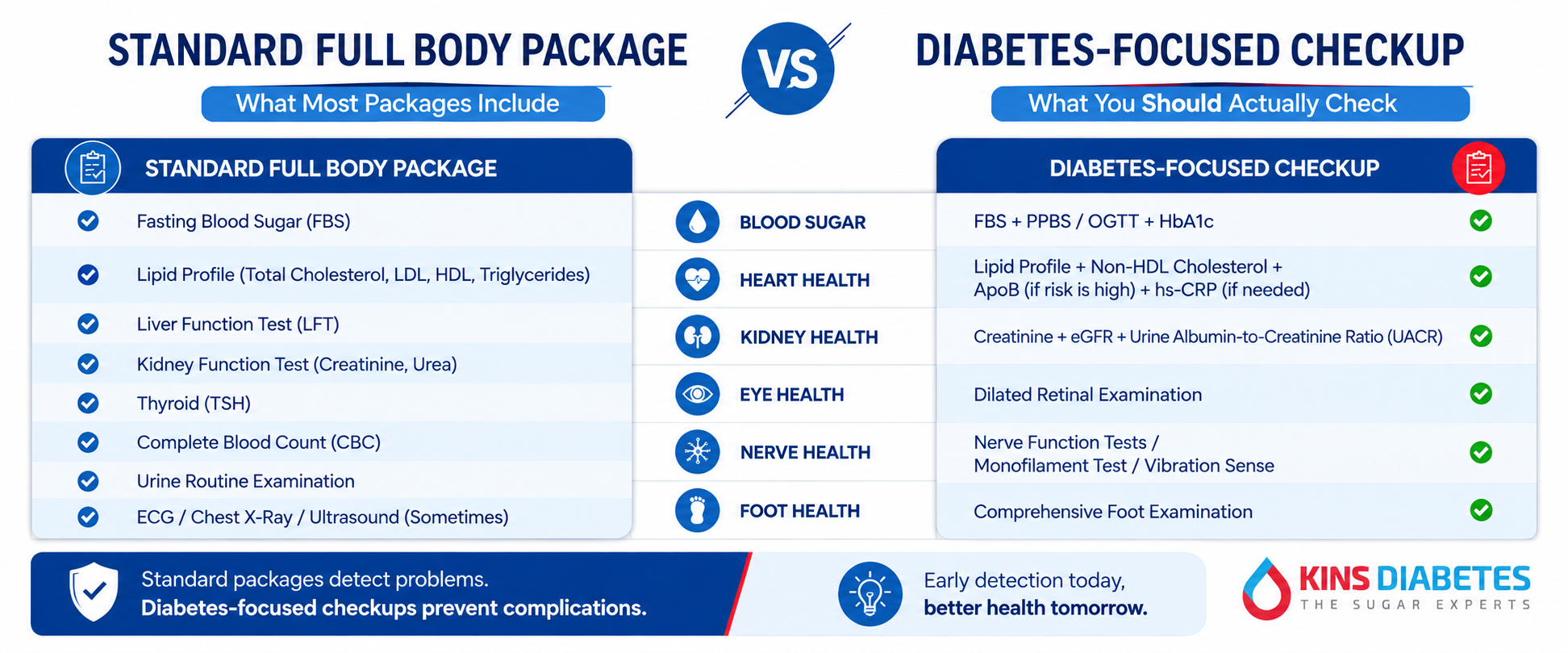
Standard Package vs Diabetes-Focused Checkup
| Area | Typical full body package | What diabetes-focused care adds |
|---|---|---|
| Blood sugar | Fasting sugar | HbA1c + post-meal sugar |
| Kidneys | Creatinine, urea | Urine ACR, eGFR |
| Eyes | Not included | Dilated retina exam / fundus photography |
| Nerves | Not included | Monofilament, vibration, reflexes |
| Feet | Not included | Structured foot & pulse examination |
| Lipids | Basic panel | Non-HDL, triglyceride–HDL pattern review |
| Vitals | Sometimes | BP, waist, BMI with Asian Indian cut-offs |
| B12 | Not included | Added for long-term metformin users |
| Interpretation | Printed report | Clinical review and a follow-up plan |
The last row is the one that matters most. A report is data. What changes outcomes is a clinician reading it against your history, medicines, weight, family background and previous reports — and telling you what to do next.
Who Should Be Screened and at What Intervals
Screening recommendations are individualized — always follow your doctor’s advice and not a generic list. That said, screening is often considered for:
- Adults from about age 30 in India, because of the earlier onset in the Indian population than in Western data.
- Anyone who has a parent or sibling who has diabetes
- Overweight or central obesity (waist circumference above the thresholds noted above)
- History of gestational diabetes or birth of a baby > 4 kg
- PCOS
- High blood pressure or abnormal fat levels
- Sedentary life style mostly
- A past prediabetes result, which usually requires repeated testing each year
- This may include symptoms such as excess thirst, frequent urination, unexplained weight loss, persistent tiredness, slow healing of wounds, recurrent infections, or tingling in the feet
If screening is normal and you have no risk factors, a common approach is to repeat every three years. More often yearly if risk factors or prediabetes result.
If you already have diabetes the routine is different. HbA1c every 3-6 months depending on control. Annual kidney, eye, foot and lipid assessment, with more frequent review if any of those show changes.
When Your Report Is Not Normal
Consider three things:
- Screening is not a diagnosis. Normally you need to confirm one abnormal value before you can conclude anything.
- Don’t interpret yourself, don’t medicate yourself. Reference ranges are method dependent and HbA1c can be skewed by conditions unrelated to diabetes.
- Prediabetes is a decision point, not a diagnosis. This is the phase when a structured lifestyle change, under the supervision of a clinician and a dietitian, has the maximum scope to work.
Bring your report with any older reports to be interpreted by a diabetes specialist. Trends over years often speak louder than a single value.
Getting Ready for Your Examination
- Fasting for 8-10 hours for fasting sugar and lipid profile. plain water is permitted. Tea, coffee and chewing gum aren’t.
- Good morning. Fasting is easier overnight and early collection prevents a long fasting period.
- Bring your medicine list including supplements and any ayurvedic or homeopathic preparations.
- Ask before skipping medicines." Do not discontinue diabetes or blood pressure tablets yourself prior to a test.
- Back carry previous reports. Trends are more important than single-day snapshots.
- Sugar after a meal is calculated from the first bite , not the end of the meal .
- Mention pregnancy, recent illness, recent blood transfusion or known anemia – all can affect interpretation.
- If a foot examination is planned, wear loose footwear.
Checklist: Ask Before You Pay Up
Copy this and send to center before booking:
- This package contains HbA1c? (If not, what’s the cost to add?)
- Is it blood sugar after eating or just when fasting?
- Is the urine albumin-creatinine ratio included in the kidney panel or just creatinine?
- Does it involve eye / retina / fundus examination ?
- Does it include a foot and nerve sensation exam?
- Does the lipid profile include non-HDL cholesterol?
- Does it have TSH?
- Is there a doctor that will go over and explain the report or is it report only?
- Does the price include a follow up consultation?
- Is blood pressure, weight and waist measured and recorded?
If the answer to question 8 is “report only” budget for a separate consultation. Unexplained report seldom changes anything.
The Takeaway
A full body check up will usually let you know if your blood sugar is high. It usually doesn't tell you if high blood sugar has started to affect your kidneys, eyes, nerves, or heart.
If you are booking for diabetes screening make sure you check that HbA1c is included. If you already have diabetes, ask for the four assessments that standard packages miss out: urine ACR, retina examination, foot and nerve examination and a lipid review – and get a doctor to sit with you and explain the report.
The most reliable way to reduce the risk of long-term complications is early detection, structured follow-up and consistent monitoring.
Diabetes Specific Health Checkup in Siliguri
At Kins Diabetes, Siliguri, health assessments for people with diabetes and those at risk are based on blood sugar testing and screening for complications such as kidney, lipid, nerve and foot evaluation, followed by a consultation to discuss the results and plan the next steps.
📞 Call / WhatsApp : +91 9733785000 📍 Location: 1st Floor, Golden Heights Building, Jhankar More, Burdwan Road, Siliguri 🌐 Book online: www.kinsdiabetes.com
This article is for general information and patient education purposes. This is not a substitute for medical advice, diagnosis or treatment. Test ranges and screening intervals are different for each person and each laboratory method. Please consult a qualified health care professional about your own health and reports.
References:
[1] American Diabetes Association Professional Practice Committee. Diagnosis and Classification of Diabetes: Standards of Care in Diabetes — 2024. Diabetes Care. 2024;47(Suppl. 1):S20–S42. https://diabetesjournals.org/care/issue/47/Supplement_1
[2] American Diabetes Association Professional Practice Committee. Retinopathy, Neuropathy, and Foot Care: Standards of Care in Diabetes — 2024. Diabetes Care. 2024;47(Suppl. 1):S231–S243. https://diabetesjournals.org/care/article/47/Supplement_1/S231/153941/12-Retinopathy-Neuropathy-and-Foot-Care-Standards
[3] Indian Council of Medical Research (ICMR). Clinical Practice Guidelines for Management of Type 2 Diabetes, 2018. Government of India.
https://main.icmr.nic.in/sites/default/files/guidelines/ICMR_GuidelinesType2diabetes2018_0.pdf
[4] National Kidney Foundation. Urine Albumin-to-Creatinine Ratio (uACR).
https://www.kidney.org/kidney-topics/urine-albumin-creatinine-ratio-uacr
[5] National Kidney Foundation. Albuminuria — Causes, Diagnosis, Treatment.
https://www.kidney.org/kidney-topics/albuminuria-proteinuria
[6] International Diabetes Federation (IDF). Clinical Practice Recommendations on the Diabetic Foot, 2017.
https://idf.org/about-diabetes/complications/nerves/clinical-practice-recommendations/
[7] International Working Group on the Diabetic Foot (IWGDF). Practical Guidelines on Prevention and Management of Diabetes-Related Foot Disease — 2023 Update.
https://iwgdfguidelines.org/guidelines-2023/
[8] WHO Expert Consultation. Appropriate Body-Mass Index for Asian Populations and Its Implications for Policy and Intervention Strategies. The Lancet. 2004;363:157–163.
https://www.thelancet.com/journals/lancet/article/PIIS0140-6736(03)15268-3/abstract
[9] de Jager J, Kooy A, Lehert P, et al. Long-term Treatment with Metformin in Patients with Type 2 Diabetes and Risk of Vitamin B-12 Deficiency: Randomised Placebo-Controlled Trial. BMJ. 2010;340:c2181. doi:10.1136/bmj.c2181
https://pubmed.ncbi.nlm.nih.gov/20488910/
Frequently Asked Questions
Read More Articles

Posted on 26-08-2026
Diabetes Diet Chart: What to Eat and What Not to Eat in Diabetes

Posted on 13-08-2026
Best Diabetologist in Siliguri: How to Choose the Right Diabetes Doctor

Posted on 07-08-2026
ডায়াবেটিসে কী খাবেন, কী খাবেন না? সম্পূর্ণ বাংলা ডায়েট চার্ট

Posted on 31-07-2026
How to Control Diabetes: The 30-Day Indian Blood Sugar Reset Plan

